
Planning ahead
Services
Second-line treatment
In vitro fertilisation (IVF, ICSI)
Egg and sperm meet in the laboratory, and the resulting embryo is transferred into the uterus. Remaining embryos can be frozen for a later attempt.
The cycle starts with ten to fourteen days of stimulation monitored at the institute, then egg retrieval under sedation. The embryo transfer follows, without anaesthesia.
The choice between conventional IVF and ICSI is made by the team in a meeting, after reviewing the complete file. Neither technique is superior in the abstract: there is a technique suited to a situation, and we explain the choice and its reasons.
Remaining embryos are frozen by vitrification. The large majority survive thawing, and a frozen embryo transfer gives results comparable to a fresh one.
Who IVF is for
In vitro fertilisation is a second-line treatment. It is offered when the fertility work-up points to it, or when the simpler ovarian stimulation and IUI do not suit the situation. The Institute never recommends a heavier treatment than your file justifies.
IVF is not only about the woman: a male factor is involved in roughly half of all cases, and the work-up of both partners guides the choice of technique.
Conventional IVF or ICSI: what is the difference?
In both cases, fertilisation takes place in the laboratory. In conventional IVF, eggs and sperm are placed together and fertilisation happens on its own. In ICSI, a single sperm is injected directly into the egg by micro-injection, under a microscope.
The choice is made in a team meeting, after reviewing the complete file, and explained to you with its reasons. Neither technique is superior in the abstract.
How an IVF cycle unfolds
Stimulation. Ten to fourteen days of daily injections at home, with several checks at the Institute to adjust doses and set the date of the retrieval.
Egg retrieval. The eggs are collected under sedation. You go home the same day.
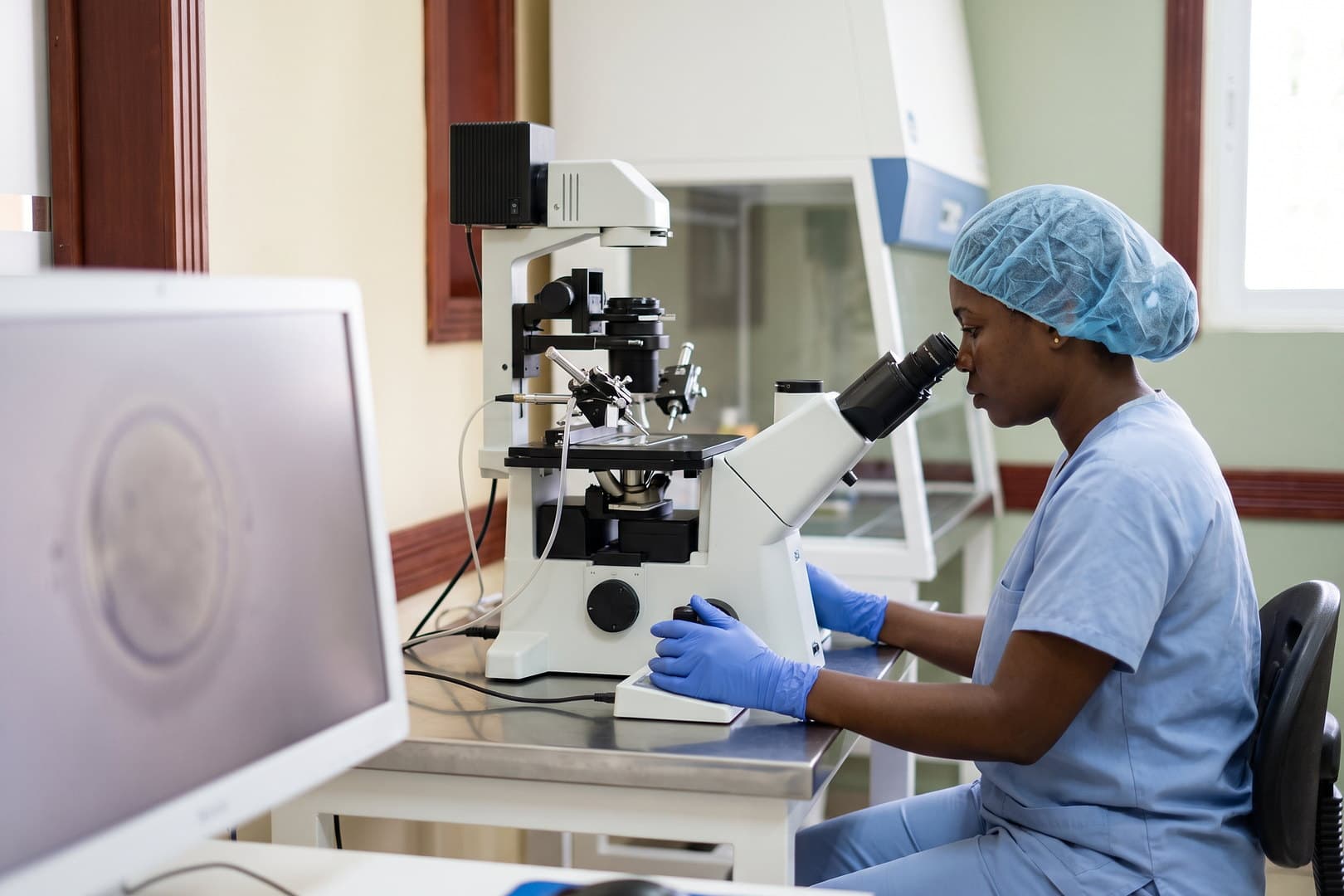
The laboratory. Fertilisation, by conventional IVF or ICSI, takes place in the laboratory, supervised by the Institute's senior embryologist, who oversees the storage of every embryo, egg and sperm sample.
The transfer. The embryo is transferred into the uterus without anaesthesia; the procedure is usually painless. The result comes twelve to fourteen days later, and we offer a support consultation during that wait.
Embryo freezing and later transfers
Remaining embryos can be frozen by vitrification, a method so fast that the large majority survive thawing. A frozen embryo transfer gives results comparable to a fresh one.
Frozen embryos can therefore be used for a later attempt. The same technique also underpins fertility preservation, through egg or sperm storage.
What to know before IVF
The Institute's team delivered Haiti's first IVF baby, in 2012. Its members have contributed to more than 450 births, with an overall IVF success rate of 28%, results achieved in their previous institutions.
No centre anywhere can guarantee an individual outcome. The number of attempts depends on your age, the cause identified and how you respond to the first cycle, and we discuss it before starting so you can prepare financially and emotionally.
You receive a full written quote before committing to anything. Stimulation drugs are billed separately and vary with the protocol.
- Stimulation monitored at the institute, then retrieval under sedation
- IVF or ICSI decided in a team meeting
- Remaining embryos frozen by vitrification
Common questions about IVF
Are egg retrieval and transfer painful?
Egg retrieval is done under sedation. The transfer needs no anaesthesia and is usually painless. Abdominal discomfort and fatigue late in stimulation are common and normal.
Who decides between IVF and ICSI?
The team, in a meeting, after reviewing the complete file. Neither technique is superior in the abstract: there is a technique suited to a situation. We explain the choice and its reasons.
Does freezing embryos reduce their chances?
No. Vitrification freezes so rapidly that the large majority of embryos survive thawing. A frozen embryo transfer gives results comparable to a fresh one.
How many attempts should we expect?
It depends on your age, the cause identified and how you respond to the first cycle. Pregnancy often does not happen on the first attempt. We discuss this before starting, so you can prepare financially and emotionally.

Dreaming of holding that baby in your arms?
You are in the right place. One first consultation is enough to understand your situation and your real options. You decide what comes next, freely.