Step 1 · for both partners
Services
Planning ahead
Fertility preservation
Storing eggs or sperm for a future pregnancy, or ahead of treatment that may affect fertility.
Two situations lead to preserving fertility: a pregnancy planned for later, and treatment known to carry a risk to fertility.
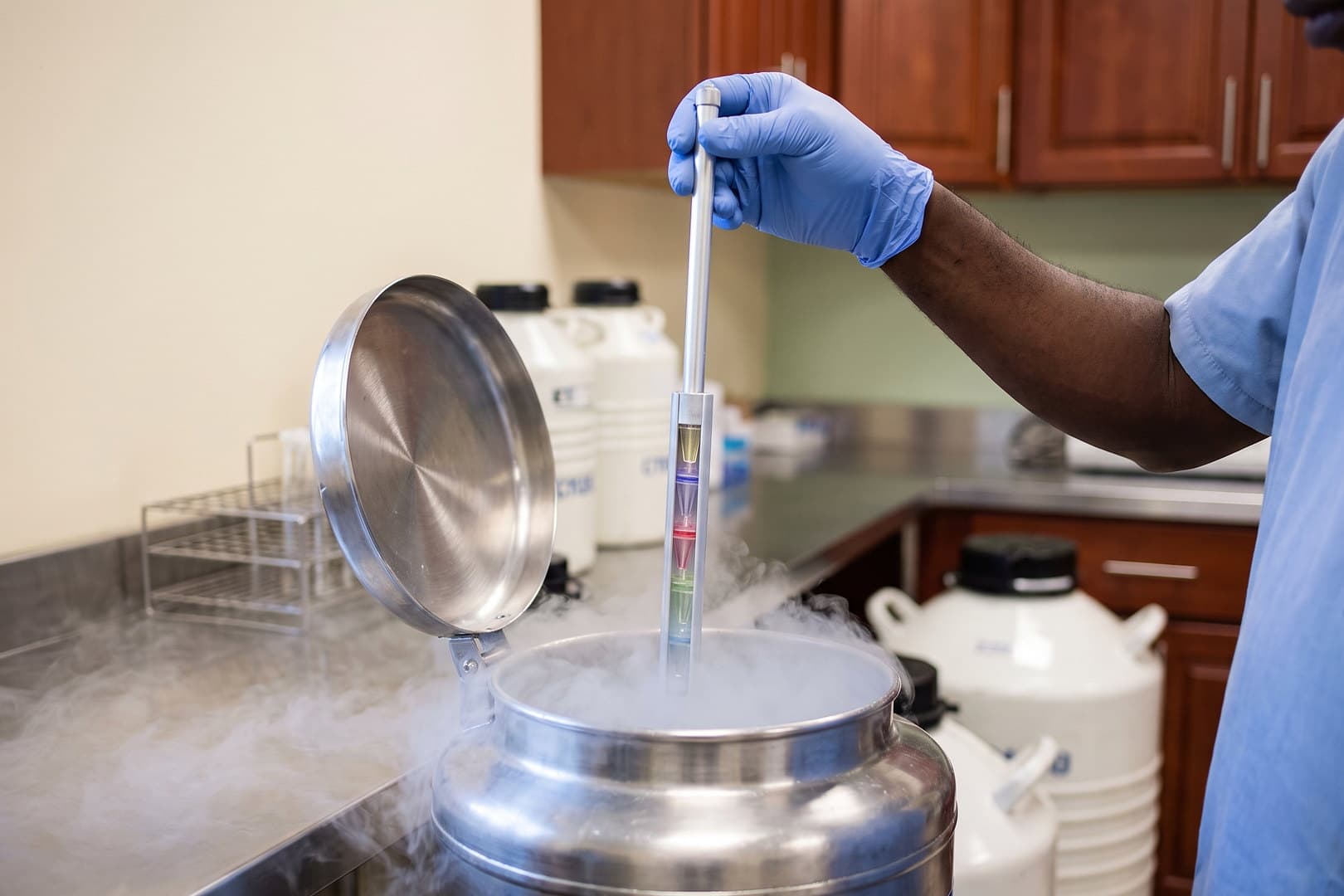
Storage relies on vitrification, a freezing method fast enough for the large majority of cells to survive thawing.
As with every pathway here, it begins with the same work-up. We then present the recommended option, what it demands and what it costs in full, and you decide with no time pressure.
Who fertility preservation is for
The first situation is a pregnancy planned for later: storing eggs or sperm today, for a family project further down the road. The second is medical: treatment known to carry a risk to fertility.
Both women and men can preserve their fertility. For women, age matters: after 35, ovarian reserve declines faster, which is a reason to raise the question early rather than wait.
Preserving fertility is a personal decision. The team explains in advance what the process demands, so you can prepare for it, and you are welcome to come alone for a first conversation.
How storage works
It begins with the work-up, as with every pathway at the Institute: consultation, tests, then results explained in person.
To store eggs, they first have to be collected. The pathway then follows the first steps of in vitro fertilisation: stimulation monitored at the Institute, then egg retrieval under sedation. You go home the same day.
For men, storage involves sperm samples, kept in the Institute's laboratory.
Work-up tests depend on specific points in the cycle, which is why it takes two to six weeks before the results appointment. Every result is explained to you in person, not by phone and not by message.
Vitrification: how cells are stored
Vitrification is a very fast freezing method, fast enough for the large majority of cells to survive thawing.
Eggs, sperm and embryos are stored in the laboratory under the supervision of the Institute's senior embryologist, Natalie King, who performed Haiti's first egg vitrification.
The same technique is used to freeze the embryos remaining after IVF: a frozen embryo transfer gives results comparable to a fresh one.
What to know before you start
Storing eggs or sperm does not guarantee a future pregnancy: no centre anywhere can guarantee an individual outcome.
Before any decision, the team presents the recommended option, what it demands and what it costs in full. You receive a full written quote before committing to anything, and you decide with no time pressure.
Your file stays confidential: nothing is shared with a third party, including a family member, without your written consent. Psychological support is available at every stage.
- Egg storage
- Sperm storage
- Ahead of treatment that may affect fertility
Common questions about fertility preservation
Who can preserve their fertility?
Both women and men, in two situations: a pregnancy planned for later, or treatment that may affect fertility. It begins with a work-up.
Does freezing damage eggs or sperm?
Vitrification freezes fast enough for the large majority of cells to survive thawing.
Is a work-up needed before storing eggs or sperm?
Yes. As with every pathway at the Institute, it begins with the same work-up: consultation, tests, then results explained in person. That work-up is what allows the team to present the recommended option.
Does storage guarantee a pregnancy later?
No. No centre anywhere can guarantee an individual outcome. The team presents the recommended option, what it demands and what it costs in full before any decision.

Dreaming of holding that baby in your arms?
You are in the right place. One first consultation is enough to understand your situation and your real options. You decide what comes next, freely.